How to cite this page Comment citer cette page
Items
-
2020, La statue de Belain d'Esnambuc est arrachée de son socle La statue est abattue et décapitée, sa tête est traînée dans les rues et déposée sur les grilles de la préfecture
-
2020, The de Gaulle statue is smeared with yellow paint On the night of June 12-13, 2020, the face of the de Gaulle statue was smeared with yellow paint, as was the plaque commemorating the battle of Bir Hakeim. June 13 is a day of demonstrations in France against police violence, called by the Collectif Vérité et Justice pour Adama Traoré (Truth and Justice Collective for Adama Traoré), and in the context of worldwide protests against police violence led by the Black Lives Matter movement.
-
2020, The statue of François de Mahy is plastered with red paint. Activists cover François Césaire de Mahy's hands and face in red paint. The color red represents the blood that flowed during the Madagascar wars, of which he was one of the instigators. At the same time, the street sign bearing his name was covered in black paint.
-
2020, La statue de Lyautey et la stèle des Goums mixtes Marocains sont aspergées de peinture rouge De la peinture rouge est lancée sur la statue de Lyautey et sur la stèle des Goums mixtes Marocains. Des inscriptions sont également peintes sur le socle de la statue. Inscriptions : : "Guerre du RIF / 1921-1926 / tu as gazé le RIF / Abdelkrim t'a vaincu / Pétain a dû / venir à l'aide" // "Colonisateur / Vive / Le RIF"// "Vive / La République / du / RIF / 1921-1926"
-
2020, La statue de Napoléon Ier est recouverte de peinture rouge 2020, The statue of Napoleon I is covered in red paint
-
2020, Victor Schœlcher statue is destroyed in Fort-de-France On May 22, 2020, the day commemorating the abolition of slavery in Martinique, the two statues of Victor Schœlcher located in Fort-de-France and Schœlcher were destroyed by activists who knocked them off their plinths. The destruction was filmed and the videos posted on social networks. The activists also publish a press release, entitled “May 22, reparation through reappropriation”, recalling that the decree abolishing slavery was signed on May 22 following the slave revolts and asserting “No, Schœlcher is not our savior”. The communiqué calls for recognition of the memory of the ancestors of the Martiniquais, and proposes the replacement of street names and public institutions.
-
2020, The statue of Victor Schœlcher is destroyed in Schœlcher On May 22, 2020, the day commemorating the abolition of slavery in Martinique, the two statues of Victor Schœlcher located in Fort-de-France and Schœlcher were destroyed by activists who knocked them off their plinths. The destruction was filmed and the videos posted on social networks. The activists also publish a press release, entitled “May 22, reparation through reappropriation”, recalling that the decree abolishing slavery was signed on May 22 following the slave revolts and asserting “No, Schœlcher is not our savior”. The communiqué calls for recognition of the memory of the ancestors of the Martiniquais, and proposes the replacement of street names and public institutions.
-
2020, The Maroon statue receives white paint Memorial statue covered in white paint, presumably as a racist attack
-
2020, The bust of Charles de Gaulle is painted over and the base is tagged The bust is painted red, and inscriptions in French and Creole are applied in red and black paint: "Respé", "1944 Massac, Massacre de Thiaroye", "Nou pa Franssé", "Tirey Isalop", "Criminel Assassin".
-
2020, The bust of Charles de Gaulle is coated in orange paint The bust of Charles de Gaulle is coated in orange paint. The word "esclavagiste" is stenciled on the base.
-
2020, The bust of Christopher Columbus is sprayed with red paint and the base is tagged The bronze bust is painted red. The same paint is used to inscribe “murderer”, “rapist” and “slaver” on the base
-
2020, The bust of Victor Schœlcher is removed On the night of July 23-24, 2020, the bust of Victor Schœlcher was removed from its base and taken away. The gendarmes find it after more than a day's disappearance in the wild on the route des mamelles, more than 40 kilometers from Basse-Terre, damaged and with its face smashed in. The base was also tagged. The damage occurred three days after the annual Day of History and Remembrance organized by the Société des amis de Victor Schœlcher, founded in 1992 and chaired by Brigitte Rodes, a lawyer and departmental councillor. The base had been repainted for the commemoration, and wreaths of flowers laid by the commune's mayor.
-
2020, The Laproptaz nout péi collective calls for a commission to be set up to consider street names and monuments in Reunion's public spaces On the day of remembrance of the slave trade and its abolition instituted by Unesco, le collectif Laproptaz nout péi publishes a press release: "We propose that you set up a public commission to study and consult on the names of streets and public squares, on the names of schools, high schools, colleges and universities, on public buildings and on the place and locations of honorary statues, so that we can achieve a balance with regard to the representation of the history and memory of this country". The collective is thus calling for the reconstruction of a public space around local historical figures who embody the principles enshrined today in the various declarations of fundamental human rights
-
2020, The Victor Schœlcher Memorial is tagged On May 27, 2020, the Victor Schœlcher pedestal in Vieux-Habitants was tagged with a red pen or pencil: the word “RACISTE” was inscribed in very large vertical letters. Smaller inscriptions appear, such as “mascarade”, “pas de raciste comme symbole !!!!”.
-
2020, The Schœlcher monument is coated in red paint On the night of July 1 to 2, both the young man and Schœlcher were painted red, a syringe was placed in Schœlcher's right hand, and what the newspapers interpreted as a torn-out heart was placed at the foot of the young man, symbolizing a freed slave.
-
2020, Le monument à Schœlcher est renversé On the night of July 17-18, 2020, the statues were knocked off their plinths. Cayenne town hall feared that the statues would be damaged or destroyed, as had happened on June 22 in Martinique. A police car had been stationed on Place Schœlcher on June 10, the day of the commemoration of the abolition of slavery in French Guiana.
-
2020, The monument to General Faidherbe is tagged On the night of June 20-21, 2020, the words "colon", "assassin", "Sénégal", "Algérie" and "Kabylie" were inscribed in white paint on the monument's base.
- 2020, The monument to General Faidherbe is sprayed with red paint
-
2020, The foot of the horse, the base and the pedestal of the statue of Napoleon receive red paint On the night of June 24-25, 2020, the monument to Napoleon Bonaparte was sprayed with red paint
-
2020, The remaining base of the Josephine statue is transformed into a permaculture planter Rouge Vert Noir activists decided to transform what's left of the pedestal base of the Josephine statue into a permaculture planter. The idea is simple: passers-by help themselves to the bin and can also contribute to the development of its crops by watering it or adding seeds. But the planter soon seems to be abandoned, attracting pests and posing a problem for the restaurant owners on the Savane, as well as for vagrants.
-
2020, Christopher Columbus' face is coated in red Christopher Columbus's face is coated in red paint. The plaque bearing his name and dates of life and death is covered in red paint.
- July 24, 2020, Activists from the Rouge Vert Noir collective issue an ultimatum to Fort-de-France town hall for the removal of the statue of Josephine
-
2020, Manifestation autour de la statue de Paul Bert Une banderole « Black Lives Matter » est accrochée sur la statue.
-
2020, Market Drayton museum curator defends statue of Robert Clive Speaking to the Shropshire Star, Ian Picton-Robinson, curator of Market Drayton Museum, run by the Drayton Civic Society, said that it was not so simple to condemn Robert Clive
-
2020, Mayor of Tower Hamlets issues a statement on the Robert Milligan statue A statement from Mayor of Tower Hamlets John Biggs on the statue of Robert Milligan at West India Quay: “The removal of the statue of a slave trader in Bristol this weekend and the Black Lives Matter campaign has made us all reflect on the symbolism of these historical representations, and I understand the strength of feeling about the statue of the slave trader Robert Milligan in West India Quay. “I’ve put pressure on the owners of the land for it to be removed, and have also asked for council officers to carry out a review of what other symbols including statues are in the borough and who owns the land they’re on. “The East End has a proud history of fighting injustice – but we must also face up to our past and learn from it to continue our fight against racism and intolerance today.”
- 2020, Medway Council publishes its report on monuments and place names
-
2020, Creation of memorial commissions in Martinique towns In the wake of the destruction of the Schœlcher statues and the death of George Floyd, which led to a worldwide wave of protests against monuments linked to the history of slavery, some municipalities set up memorial commissions, tasked with shedding light on the history of Martinique and proposing personalities who had fought against slavery to be honored. In Fort-de-France, the Memory and Transmission Commission was set up on June 17, 2020, with the mission of “initiating a reflection and action plan on a certain number of statues, symbols and names in the public space that refer to the colonial and slave-owning period, and proposing new references that resemble us and bring us together”. A commission was also set up in La Trinité by a vote of the town council on June 29, to consider changing certain street names.
-
2020, Murad Qureshi expresses his opinion of Robert Clive statue in London Murad Qureshi, British Labour politician, explained in an interview with the magazine The Week why Robert Clive's statue in London should be removed.
- 2020, Murder of George Floyd
-
2020, Museum of London issues a statement on the Robert Milligan statue A Museum of London spokesperson said: “The statue of Robert Milligan has stood uncomfortably outside the Museum of London Docklands for a long time, one of only three museums in the UK to address the history of the transatlantic slave trade. Robert Milligan was a prominent British Slave trader who, by the time of his death in 1809, owned 2 sugar plantations and 526 slaves in Jamaica. A statue made by Sir Richard Westmacott was moved in 1997 to West India Quay, opposite the Museum of London Docklands, in honour of Milligan’s ‘genius, perseverance and guardian care’, as a commemoration to his achievements. The Museum of London recognises that the monument is part of the ongoing problematic regime of white-washing history, which disregards the pain of those who are still wrestling with the remnants of the crimes Milligan committed against humanity. At the Museum of London we stand against upholding structures that reproduce violence, and have previously engaged in interventions that critically engage with pro-slavery lobbying. We are committed to the processes of learning and unlearning as fostered in our London, Sugar & Slavery gallery, which opened in 2007 at the Museum of London Docklands. This gallery tells the history of the transatlantic slave trade and London’s involvement as once the fourth largest slaving port in the world. The museum, being another physical manifestation of slavery situated in an old sugar warehouse, constantly challenges the contentious nature of this history. Now more than ever at a time when Black Lives Matter is calling for an end to public monuments honouring slave owners, we advocate for the statue of Robert Milligan to be removed on the grounds of its historical links to colonial violence and exploitation. We are currently working with a consortium to remove this statue and are aware of other legacies and landmarks within the area. The statue presently stands shrouded with placards and is now an object of protest, we believe these protests should remain as long as the statue remains.”
- 2020, Museum of the Home announces it will retain and explain the Robert Geffrye statue
- 2020, National Trust removes Dunham Massey Hall sundial
-
2020, Amateur cleaning of the Marchand mission monument To remove the red paint and bitumen. Organized by a group that summoned the media
-
2020, Nettoyage improvisé de la statue de Lyautey Trois adolescents nettoient la statue à l’eau de javel et à la brosse et déclarent à un journaliste de CNews : "“on ne peut pas lutter contre le racisme en voulant effacer ou bien salir une partie de l’histoire de France. Pour moi il faut au contraire regarder ces périodes et ces personnages avec lucidité, et voilà le modèle de la France c’est un modèle peu importe la couleur de peau on doit se rassembler derrière un passé commun, le même drapeau”
-
2020, Online petition against the removal of the Redvers Buller statue The petition, which had 9,317 signatories (as of April 2nd 2024), laid out the following argument against the statue's removal: "Exeter City Council has called for a review to remove this much loved statue to a man who was much loved in Devon in his time. General Buller VC was a war hero who won the Victoria Cross during the Zulu War, where he carried three men to safety during the defeat at Hlobane. The statue was paid for by public subscription, by the ordinary people of Devon. The petition to remove this statue states that Buller had a "major hand" in the establishment of Boer concentration camps, but this is simply not true. Though he was the British commander at the outbreak of the Boer War, he was replaced in January 1900 by Lord Roberts. And it wasn't until Kitchener then took command in late 1900 that the concentration camp policy was established. We cannot stand by and let historically illiterate people erase our history. And then there is the bigger picture. We are currently seeing our nation's heritage being chipped away on the crest of a small but noisy wave of protest. We should not make the mistake of judging history through the lens of our own morality, for nobody would pass that test. The silent majority of this country want our public monuments to remain. They belong to us all and represent our heritage."
-
2020, Online petition against the removal of the Stapleton Cotton statue
The petition, which had 1,523 signatories (as of April 2nd 2024), laid out the following argument against the statue's removal. It is worth nothing the clear attempt to downplay and excuse Cotton's slave-ownership ("Like all Caribbean estates at the time..") within its argument. "Field Marshal Stapleton Cotton was a hero of the Napoleonic Wars - victory in which saved Europe from tyranny - and, as such, is worthy of his place in history and of our respect. In 1810 he was appointed to overall command of the cavalry in the Peninsular War and he was Wellington's Second-in-Command at the Battle of Salamanca in 1812. In 1825 he was appointed to Commander-in-Chief in India, where he restored the Raja of Bharatpur with a much celebrated siege of that fort. Like all Caribbean estates at the time, his included enslaved people, but it is incorrect to say that he was a 'slave trader'. And to suggest that the statue glorifies this aspect is patently foolish. It celebrates his military achievements, which stand as an inspiration to the people of Chester and of Britain. And then there is the bigger picture. We are currently seeing our nation's history being chipped away on the crest of a small but noisy wave of protest. We should not make the mistake of judging history through the lens of our own morality, for nobody would pass that test. The silent majority of this country want our public monuments to remain. They belong to us all and represent our heritage."
-
2020, Online petition to change the name of Blackboy Road in Exeter The petition, which garnered 2,907 signatures as of April 5th 2024, laid out the following argument for changing the name: "Blackboy Road in Exeter is named after King Charles II. Charles had a darker complexion, different height and features from those around him which led to him being known as "Black boy". I think the fact this hasn't been changed already is insensitive and ignorant so having just moved into the area and learned the history behind the name, I want to see it changed. It's 2020 and we still have a road named after a racist nickname given to one of our monarchs. Please get behind this by signing the petition and sharing with as many people as you can. Thank you."
-
2020, Online petition to keep the Horatio Kitchener statue The petition, which had 4,225 signatories (as of April 2nd 2024), laid out the following argument against the statue's removal: "Lord Kitchener was a hero of his time and a leading engineer in military innovation. Many of his initiatives in railway construction in the Sudan led to British Engineering successes around the world. Local press are publishing misdirected information about him with the intent of removing his statue in Chatham. This would be an insult to the local military and their engineering history. We request you save the statue and work with the RE museum to show the really Lord Kitchener for who he was."
- 2020, Online petition to keep the name of Blackboy Road in Exeter
-
2020, Online petition to remove the Horatio Kitchener statue The petition, which had 637 signatories (as of April 2nd 2024), laid out the following argument for the statue's removal: "In life, Lord Kitchener oversaw the first ever concentrations camps during the Boer Wars. Over 100,000 black Africans were captured and while tens of thousands died, no records were kept. 25,000 white women and children died in the camps. Now, Kitchener’s statue overlooks all of Chatham, despite having no connection with the Medway Towns whatsoever. We need to learn our real history, not celebrate those who were responsible for mass suffering. Take Down Kitchener!"
-
2020, Online petition to remove the Neill statue in Ayr The petition, which had garnered 1,186 signatures as of April 17th 2024, laid out the following argument for the statue's removal: ""A brave, resolute and self-reliant solider, universally acknowledged as the first who stemmed the torrent of rebellion in Bengal". Thus reads the plaque beneath the statue of James George Smith Neill, that stands pride of place in the centre of our town. But who was this man? James George Smith Neill (27 May 1810 – 25 September 1857) was a Scottish military officer of the East India Company, who served during the Indian rebellion of 1857. The rebellion was born from resentment of invasive British-style social reforms, harsh land taxes and summary treatment of some rich landowners and princes, amongst other injustices. General Neill was infamous for numerous indiscriminate killing of Indians in the aftermath of a local massacre, including the execution of prisoners. In one episode, he is said to have rounded up Brahmins, who had had nothing to do with the event, to wash up the blood of uprising victims from the floor while they were whipped with cat-o-nine-tails until they collapsed. At this point, these innocents were summarily executed by hanging. The statue of Neill is a personal insult to those of us in Ayr whose ancestors suffered under the British occupation of India. Indeed, we believe that the veneration of such a man stands in stark opposition to the values that we would wish to strive for as a town. We who have signed this petition are clear that this man is not a part of our history we wish to be celebrated. It is high time that the statue was removed from its current location. Instead, we implore the council to have it placed in a museum, where it can be used to educate future generations about the role of Scottish military officers in the British Empire."
-
2020, Online petition to remove the Robert Milligan statue The petition, which garnered 5,184 supporters, laid out the following argument for the statue's removal: "Robert Milligan (1746-1809) was a leading figure in building the east London docks, in part, to trade in slave-harvested goods from the Caribbean. Milligan owned 526 slaves who worked at his sugar plantation and much of his wealth was acquired through the trade and exploitation of slaves. While we as East Enders and Londoners express our solidarity chanting Black Lives Matter, it is painful to walk past a proud statue of Robert Milligan which was erected to commemorate and celebrate his life. Milligan has no place in London, and he does not deserve the honour of a statue. This should be reserved for those who have fought for equality and social justice this world is desperately crying for. Following the events in Bristol and to express our solidarity to our black brothers and sisters throughout the world it is only right that we remove the proud statue of Robert Milligan from West India Quay in Canary Wharf, Tower Hamlets. As much as we appreciate the value of history, we should not glorify the enslavement of individuals by displaying a statue of a slave trader. The East End has a proud history of fighting against injustice and inequality. Today it is our duty to remove this symbol which only resonates pain, suffering and inhuman treatments of fellow human beings for profit."
-
2020, Online petition to remove the statue of Stapleton Cotton The petition, which garnered 1,453 supporters, laid out the following argument for the statue's removal: "Stapleton Cotton, 1st Viscount Combermere was a joint owner of a number of plantations on St Kitts and Nevis between 1822 and 1834. He was appointed the Governor of Barbados in 1817 meaning he was involved with overseeing the operation of plantations, slaves being shipped in and out of the island through purchase and sales of African people and the overall use of slaves on the island. He also received a considerable amount of compensation (around £920,000 in today's currency) for the loss of 420 enslaved people, at the time of release, on his estates. Work began on his monument in 1864 and it was finally erected in October 1865, 8 months after his death. It is said to represent his distinguished cavalry career in the military. The pedestal is even engraved with a list of major conflicts he was involved in, but there is no mention of his links to the slave trade and how he profited from it. Even his Wikipedia page only dedicates a paragraph to his connection whilst his military career is outlined in detail. The statue stands on a “prestigious site” opposite Chester Castle and in January 1972 became a Grade II* listed building meaning it is viewed as a "particularly important building of more than special interest”. We are petitioning to have the statue removed from its “prestigious site” in Chester and possibly placed into a museum where people will be able to learn about Combermere’s full history. We do not believe that the removal of these statues and the changing of street names is the sole way to remove the systemic racism that is deep rooted in our country and its history. It is also not a way for us to try and “remove” the past as this is not possible. We are also not discounting the achievements of these commemorated individuals but rather revealing the reality that comes with / behind some of their success. We do however believe that in doing this we are taking small steps towards educating the UK about our TRUE history and hope that this education will create some change in the fundamental issues our country was built upon."
-
2020, Online petitions to remove the Redvers Buller statue Two petitions, which had 386 and 72 signatories respectively (as of April 2nd 2024), laid out the following arguments for the statue's removal. Petition 1: "A statue of Redvers Buller stands at the junction of New North Road and Hele Road in Exeter, outside Exeter College. Buller was a British imperialist. He led the British Army in South Africa, including as a Lieutenant Colonel in the Anglo-Zulu war of 1878 and later as Commander-in-Chief of British Forces in the early months of the Second Boer War in 1899. Under his leadership, the British Army massacred thousands of Zulu people in order to expand the British Empire. We call for the statue of Redvers Buller in Exeter to be removed from its position and placed in the museum for educational purposes. It is not acceptable for Buller to be remembered as a hero of Devon." Petition 2: "Remove the Statue of General Redvers Buller from Hele Road Exeter. Redvers Buller was a General during the Boer War, he had a major hand to play in the introduction of concentration camps in South Africa when the Afrikaans fought the British Empire for their involvement in colonising their country. I am an 18 year old that's lived in Devon all my life and every time I see the statue I am confused and concerned as to why it is there due to Buller being seen as a failure and more importantly a cynical colonialist during this horrific War. Currently, Black Lives Matters is growing and extending across the world and with the Edward Colston statue being taken down in Bristol, I believe that this should also be removed to replace the outdated history with a future that reflects equality and eradicates the horrendous past. I believe that Exeter City Council are currently reviewing it however this is not good enough, the statue needs to be gone. Thank you."
-
2020, Painting and bitumen on the Marchand mission monument Red paint on the hands of the Europeans and a large patch of black bitumen on the monument
-
2020, Black paint on the statue of Voltaire in Paris Head and base are covered in black paint
-
2020, Red Paint thrown on the statue of Voltaire in Paris On the heead and the base
-
2020, Petition to Westminster City Council to remove the statue of Robert Clive An e-petition started by Meera Somji ran from 11/06/2020 to 28/07/2020 and gathered 333 signatures. The petitioners argued: 'There are three main reasons to remove the statue: 1. The glorification of a mass murderer and looter in the heart of the nation’s capital is profoundly insulting 2. The location of the statue at the entrance to the FCO tells visitors that the British state condones the murderous activities of Robert Clive. It also tells our civil servants, MPs, and Whitehall staff that they are furthering his work 3. It’s time to improve the education that we receive about the British Empire, which starts with removing a statue that glorifies rather than educates The council can consult on where to preserve the statue. Westminster Council responded that it does not have authority to remove the statue, which is managed and owned by English Heritage, on licence from Historic England, which in turn is under the Department of Digital, Culture, Media and Sport.
-
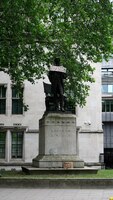 2020, Protest graffiti and placard on the statue of Abraham Lincoln The letters "A C" were graffitied in front of the ABRAHAM LINCOLN inscription (i.e. ACAB, or All Cops Are Bastards). A placard with the words HATE KILLS LOVE HEALS was placed in Lincoln's arms.
 - 2020, Protesters topple statue of Edward Colston