How to cite this page Comment citer cette page
Items
- 1901, Redvers Buller is dismissed from the British Army
-
1902 le buste "l'esclavage" d'Etcheto est installé dans le parc Beaumont à Pau Il n'y a pas d'inauguration officielle. Le socle mentionne seulement le nom de l'artiste : Jean-François Etcheto (1838-1889)
- 1902, Buller Memorial Committee decides to build a statue of Redvers Buller in Exeter as a memorial
- 1902, Debate held on Redvers Buller in Parliament
- 1902, Inauguration of the Monument to Villebois-Mareuil
-
1902, Installation and destruction of the monument to Victor Schœlcher, Saint-Pierre The monument was commissioned by a committee formed in Saint-Pierre a few days after Victor Schœlcher's death, in January 1894, to erect a monument in his honor. The statue disappeared before its planned inauguration on July 21 (the anniversary of Schœlcher's birth), when the town was destroyed by the eruption of Mount Pelée on April 23, 1902.
- 1902, Ladysmith Day held in Exeter
- 1902, Treaty of Vereeniging ends the Second Boer War
-
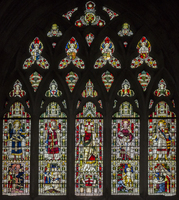 1903, Boer War memorial window and tablet unveiled in Exeter Cathedral
 - 1903, Buller Memorial Committee commissions Adrian Jones to produce the statue of Redvers Buller
-
1903, Buller Memorial Committee locates a site for the Redvers Buller statue in Exeter The site chosen was the triangular space opposite the entrance to Hele's School (today Exeter College).
- 1903, Crediton Arts and Crafts Exhibition
-
1903, Inauguration of monument to Surcouf. The inauguration ceremonies were marked by criticism of the monument's location and by political competition and conflict (the Minister of the Navy forbade representatives of the army and navy to take part).
- 1903, Installation of the statue of Charles Gordon in Khartoum, Sudan
- 1903, Ladysmith Day held in Exeter
- 1903, Redvers Buller testifies before the Royal Commission on the South African War, 1899-1900
- 1903, Redvers Buller unveils a Boer War memorial in Bermondsey
- 1904, Adrian Jones sends a bust of Redvers Buller to King Edward VII
-
1904, Inauguration of the monument to Victor Schoelcher, Fort-de-France The inauguration, initially scheduled for April 27, the day of the signing of the decree abolishing slavery, and postponed until July due to elections scheduled for May, was finally organized for September. Major festivities are organized over three days (illuminations, horse races, pirogue races, parades, poems and songs, etc.). Numerous political figures and associations are invited to the event, including the Presidents of the Republic, the National Assembly and the Senate (who decline to attend), the Governor and the Senator and President of the General Council. Companies and schoolchildren march in the inaugural parade
- 1904, Ladysmith Day held in Exeter
- 1904, London Devonian Dinner pays tribute to Redvers Buller
-
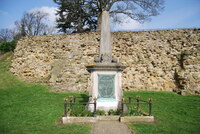 1904, Redvers Buller unveils a Boer War memorial in Tonbridge
 - 1904, Work begins on preparing the site of the Redvers Buller statue in Exeter
- 1905, Executive Committee of Devonians meeting in London
-
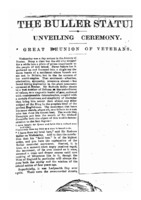 1905, Exeter Flying Post article on the Redvers Buller statue
 - 1905, Garnet Wolseley agrees to unveil the statue of Redvers Buller in Exeter
- 1905, Garnet Wolseley announces he is unable to unveil the statue of Redvers Buller in Exeter for medical reasons
-
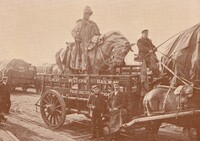 1905, Installation of the Redvers Buller statue in Exeter
 - 1905, Ladysmith Day held in Exeter
-
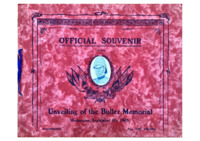 1905, Official Souvenir of the Unveiling of the Buller Memorial Fourteen page illustrated official souvenir booklet for the unveiling of the statue of Redvers Buller in Exeter on September 6 1905. The author is anonymously given as "Oaken". The official souvenir details Buller's career in the British Army, his medals, a biography of the sculptor Captain Adrian Jones, the story of the Buller statue campaign, and the order for the day's events.
 - 1905, Redvers Buller unveils a Boer War memorial in Nuneaton
-
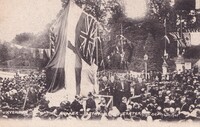 1905, Unveiling of the Redvers Buller statue in Exeter The statue of Redvers Buller was unveilled on September 6th, 1905. Redvers Buller himself attended the proceedings, as well as other colonial soldiers such as Paul Methuen and Frederick Stopford. The official proceedings for the day commenced with a Civic welcome at the Exeter Guildhall to the Lord-Lieutenant of the County, Mayors of Western Counties, and others. A procession then made its way to the cross-roads opposite opposite the entrance to Hele's School, where a stand facing Bury Meadow had been erected for ticket holders. Members of the Western Counties' Musical Association, Exeter Oratorio Society, and the Male Voice Choir were were placed on a platform by the gate of Hele's school, while the other two sides of the square were reserved for the general public. At 1 o'clock in the afternoon, the Lord-Lieutenant of Devon, Hugh Fortescue, 4th Earl Fortescue and Viscount Ebrington, took up his position on the platform, accompanied by the Mayor of Exeter, the Sheriff, the Mayor's Chaplain, and Mr. A. E. Dunn (chairman of the Committee). The speakers provided a history of behind the campaign for a statue of Buller, which originated from a meeting held in the Guildhall in 1901. Fortescue then read a speech from Garnet Wolseley (whom Buller had served under during the Anglo-Ashanti wars in 1870s), who had intended to speak at the ceremony but missed it due to poor health. An extract of Wolseley's speech read as follows: "From my heart I congratulate Sir Redvers upon being so justly appreciated in this his own loved county, long famous for its fighting leaders, as well, as he has always been, in the Army, where I had the privilege of serving with him for many years. This statue will remind future generations of Western men of the brilliant services performed by Devonshire’s most illustrious son of this period, and cannot fail to inspire them with a desire to serve our Sovereign in their turn as well and as faithfully as Sir Redvers Buller had done throughout his long and brilliant career" A Union Jack flag covering was then removed to reveal the statue to the public. After musical renditions of 'Land of Hope and Glory' and the National Anthem were performed, a reception was held at Exeter's Victoria Hall.
 -
1906, George Lambert attacks St. John Brodrick over his visit to Devon and refers to the Redvers Buller statue George Lambert referred to Brodrick's involvement in the controversial dismissal of Redvers Buller in 1901, stating that 'I believe Mr. Brodrick's action with regards to General Buller was outrageous. While Mr. Brodrick has long been forgotten, the Buller statue will remain down through the ages, and his renown will live on as one of the best and truest soldiers of the British Empire.'
- 1906, Installation of the statue of John Nicholson in Delhi, India
- 1907, Lord Curzon writes in the Times affirming the need for memorials to Clive
- 1907, Redvers Buller unveils a Boer War memorial in Warrington
-
1907, William Forwood writes to The Times lamenting the lack of a memorial to Clive The letter says: LORD CLIVE TO THE EDITOR OF THE TIMES. Sir,—India has many monuments erected in honour of successful and popular Viceroys and others who have served her well, but I have been unable to discover any monument to Lord Clive, to whom more than any other human being we owe our great Empire of India. Westminster Abbey contains no record of the great soldier statesman. . ...,In the "by-ways of - Shropshire, in the quaint little church of Morton-Sayo, the village swain sits . Sunday after Sunday over the grave of Lord Clive—no inscription marks.it, not even his name ; a small brass plate hid away over .the vestry. door.and scarcely legible is • the only record, that the. remains of Robert Clive rest within jts walls. ... . .,Truly Lord Clive rondo. Indian but in tho making of it he aroused, jealousies and political enmity which, acting upon a too sensitive nature, brought him to a premature death. But should He be forgotten ?,■ The good work which. Lord Curzon did for India in,every direction. isi I em; glad to find, gratefully recognized and "appreciated by-her. people ; among the many excellent things, he'accomplished-; was the preservation of het ancient monuments and historical records ; and, if he had ■ remained' in' office, I am sure the memory of his illustrious predecessor would not have been forgotten.,"toe ^aidan'CalCTttAwori^ eniichgd. if it.embraced a monument., to Lord, Clive ; Westminster Abbey would mo"ro:traly; reflect all that is great (and . worthy in Eriglarid’ahistb^y,if. it containedhome, appropriate record, pi Robert^ivo’and ‘what he did to huild-up.her Empire.,/ ' Youih..truly,"i William Forwood, Chairman of Quarter Sessions, Lancashire, Grand Hotel Calcutta, February-8.
- 1908, Funeral for Redvers Buller
-
1909, Call to erect a statue to Emir Abd-el-Kader. The French newspaper published in Algiers, Al-Akhbar, in favor of extending the rights of Algerians, calls for a statue of Emir Abd-el-Kader to be erected in a public square in Algeria. A similar demand is defended by the Revue Indigène.
-
1909, Dégradation de la statue de Paul Bert La statue est souillée par les Camelots du roi.
-
1910, Creation of the Committee to build a monument to Lieutenant-Colonel Germain The town of Brive, the commercial section of the Société de géographie commerciale, chaired by Germain before 1906, the Ecole Polytechnique alumni association and the Brive College alumni association set up the committee, chaired by Eugène Etienne, MP for Oran and Vice-President of the Chamber of Deputies.
-
1911, Lord Plymouth writes to Tweed offering a print of a Gainsborough portrait of Clive On 23 November, 1911, Robert Windsor-Clive, Lord Plymouth wrote to Tweed from Garlant's Hotel, Suffolk, saying, "Dear Tweed, I have found a very fine impression of Mr Ardle's print of the Gainsborough portrait of Clive. When it has been framed and glazed, and it is in too fine a state to risk dirtying and rubbing without a glass, I will send it to you and I hope you will find it what you want to work from. Yours sincerely, Plymouth"
-
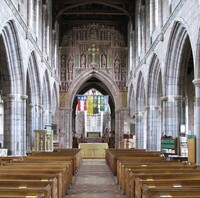 1911, Memorial to Redvers Buller in Crediton Parish Church unveiled
 -
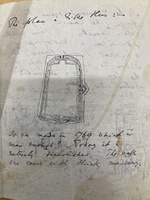 1911, Perceval Landon provides sketches of the Arcot fort for Tweed In 1911, in order to assist Tweed in visualising locations he had never seen, his friend Perceval Landon wrote him a letter, enclosing very rough sketches of the Fort of Arcot, and the scene of the battle with Clive in it. Landon wrote: My dear Tweed, I spent yesterday afternoon groping about at the India Office with Foster and Thomas. There is no drawing or plan of Arcot except a little one, unsealed, of which I send you a rough copy. Arcot was walled about by a rampart 5 miles in circumference. Inside this wall was a smaller fort. If the walls of the fort was of the same kind as the wall of the town, they were 24 feet at the base and 12 feet broad at the top. It is especially noted tat the top of the wall was too narrow for the convenient use of guns. So the plaque will have to show the fun being used at the level of the drawbridge. The plan is like this. [Then he makes a sketch] It was made in 1769 which is near enough. Today it is entirely demolished. The walls are cased with thick masonry. In the Diwani scene, the fringe of the canopy is just golden towels. I am printing and sending you a photograph of a typical Mogul throne. It shows the legs, the steps, and the low carved and perforated balustrade. Why not take the scene at the treaty in Arcot somehow like this: - [The sketch of the fort follows] It was made in 1769 which is near enough. Today it is entirely demolished. The walls are cased with thick masonry. In the Diwani scene, the fringe of the canopy is just golden towels. I am printing and sending you a photograph of a typical Mogul throne. It shows the legs, the steps, and the low carved and perforated balustrade. Why not take the scene at the treaty in Arcot somehow like this. [This is followed by a very jumbled sketch of the battle scene, with Clive in it.]
 -
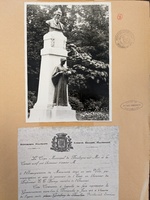 1912, Inauguration of Monument to Doctor Hamy. The monument had been ready since November 1911, and installed in the Place Godeffroi de Bouillon, in the center of the old upper town, but the committee preferred to wait until spring for the inauguration. In March, when the municipality began to prepare for the inauguration, Mademoiselle Dubard-Hamy, the statue's daughter, with the support of the mayor of Boulogne-sur-Mer, asked that the monument be moved to a more tree-lined and airy location. After obtaining the agreement of the sculptor, the mayor moved the monument to the Boulevard du Prince Albert, at the foot of the ramparts of the old upper town.
 -
1912, Perceval Landon praises Tweed for his Clive statue In a letter written by Perceval Landon from 83 Charlwood Street, S.W. [London] to his friend John Tweed, Landon said: "My dear Tweed, I cannot thank you properly for that splendid figure. He dominates the room and is so much more than merely Clive. It is the likeness of all the strong men in that small first class of Englishmen; and there is not a shadow on his face or a wrinkle on a boot that I would alter. He comes like a [...] of vitality and strength into the quietism of the Buddha, and at this moment is hooking an eye on me that is going to make me do much more work than I want to. How the man stands in his boots! Tweed, I thank you with all my heart. One day you must block out the head of Shakespeare in his later years getting a little fat and bloated, undistinguished of geature and a trifle coarse of texture - and out of [...] a face the eyes that saw an [sic.] life and saw it steadily and sanely. I am leaving London again today. Back on 4th when I hope to see you. P.L." The letter is dated September 25th, there is no year; it is difficult to be sure which year this is, since the principal bronze statue of Clive was unveiled in August 1912, but there was also a copy in marble made to be sent to Calcutta, and another, in smaller size, to be displayed in the Royal Academy (later moved to the Tate). Thus, the year is ascribed, and may be incorrect.
-
1912, Subscription for a monument to Christopher Colombus Souscription privée annoncée dans la presse locale pour ériger un monument à Christophe Colomb sur le lieu où il a accosté en Guadeloupe en 1493
- 1912, Statue of Robert Clive unveiled outside Gwydyr House, Whitehall, London
-
1913, Inauguration of the Schœlcher bust, Basse-Terre
The bust was inaugurated for the first time on July 14, 1913, to mark the national holiday of the French Republic. It is located in the administrative capital of Guadeloupe, on the exact spot where Governor Layrle proclaimed the act of emancipation on May 27, 1847, before the text arrived on the island. On July 21, the feast of Saint Victor, a second ceremony takes place at the foot of the bust, and in Pointe à Pitre, where another bust is installed in front of the museum, becoming the rallying point for mobilizations in defense of freedoms.
-
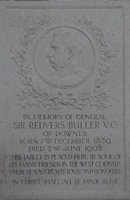 1913, Memorial plaque to Redvers Buller unveiled in Exeter Cathedral