How to cite this page Comment citer cette page
Items
- 1940, Destroyed Mangin monument as symbolic site of resistance to German occupation
-
1940, The statue of Jean-Baptiste Marchand was partly dismantled The bust of Marchand is removed and installed in the Musée de la France d'Outre-Mer to prevent the monument, which only lacks the bronze elements (shield and mast), from being inaugurated by the Germans to stir up Anglophobia.
-
1940s, Blackboy Clock mechanism stops working Stroud News gave the following summary of events: "We understand a movement is on foot to restore to activity the somnolent Black boy on the facade of Castle Street Girls’ School [...] a number of a years has passed since the Black Boy’s mechanism broke down. [...] there is a distinct revival of the sentiment for the quickening of the Black Boy of Stroud. We hope this will be effected by either the school authority or public subscription."
-
1941-1942, Refonte des éléments en bronze du monument Germain Le tirailleur et le bouclier (décembre 1941), puis le buste de Germain (janvier 1952) sont enlevés et envoyés à la refonte. Les 800 kg de bronze du tirailleurs représentent l'essentiel du bronze récupérés sur les monuments de la ville.
-
1941-1943, Melting en masse of statues in France Le 11 octobre 1941, le gouvernement de Vichy adopte une loi pour la « récupération des métaux non-ferreux » et crée une commission nationale et des commissions départementales chargées de désigner les statues à fondre. On estime que 1 700 statues ont été détruites entre 1941 et 1943 dont plus d’une centaine à Paris. Le métal récupéré a été livré aux Allemands. Les deux tiers des statues envoyées à la refonte représentaient des personnalités nationales ou locales. Le choix entre les statues à conserver et à sacrifier a obéi à un mélange de motivations politiques et esthétiques. Tout en étant convaincues que la « statuomanie » des cent dernières années avait encombré l’espace public de statues trop nombreuses et souvent médiocres, les villes et les communes, parfois la population, ont défendu « leurs » statues devant les commissions. Certaines ont été volées et cachées par patriotisme local et pour ne pas livrer de métal aux Allemands.
-
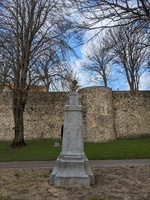 1941-1946, Removal of bronze figures from monument to Doctor Hamy. The bust and allegorical figure disappeared during the Second World War. They appear on the lists of monuments destined to be removed for reconstruction. They were not targeted for their link with colonization. However, only the bust of Doctor Hamy is replaced by a stone copy, while the allegorical female figure holding a human skull and a measuring instrument remains absent. The most likely hypothesis is that there was not enough money to reproduce the figure, but it is also possible that after the war, with the evolution of human sciences, it was not deemed desirable to reinstall in the public space an allegory of craniology and the racial classification of mankind.
 -
1941, La statue de Voltaire placée en face de l'Institut est envoyée à la refonte 1941, 1941, The statue of Voltaire in front of the Institut was recast.
- 1943, Transfer of the Robert Milligan statue into storage
-
1944, the statue of Villebois-Mareuil was removed to be melted down, then reinstalled by the Germans The statue of the soldier was one of the works destined for the foundation during the Second World War. A press article draws attention to Villebois-Mareuil's Anglophobia and his fight against the English, and the statue is reinstalled without his saber, which was broken when the statue was removed.
- 1944, Plaque commemorating the destruction of the Mangin monument on its site
-
1946, Inaugural meeting of the York Civic Trust is held The first meeting of the York Civic Trust was held in in the Mansion House, official residence of the Lord Mayor of York. It was chaired by Archbishop of York, Dr C.F. Garbett, and the historian Prof. G.M. Trevelyan made a speech saying that the association's functions should be not only to preserve the beautiful antiquities of York but to develop a 'positive informed public opinion and cultivated taste.' He acknowledged that tastes changed with time and beautiful buildings would be built in the twentieth and twenty-first century too, but emphasized that the key words should be 'beauty, tradition, dignity and cleanliness.' The Archbishop, in moving for the adoption of the constitution, said that ancient buildings and interesting places had four major enemies: time, malice, commercial greed and ignorance, of which the last was the worst.
- 1947 Reconstruction du monument Mangin approuvée par la Commission nationale des monuments commémoratifs
-
1947, Restauration et nouvelle inauguration du monument Germain Le buste a été refait à l'identique en pierre. Ajout d'une inscription : CE MONUMENT A ETE MUTILE / PAR LES ALLEMANDS / LE 21 JANVIER 1942 / ET PARTIELLEMENT RECONSTITUE / LE 14 JUILLET 1947. La statue du tirailleur n'a pas été refaite.
-
1949, Anniversary of the hundredth anniversary of Galliéni's birth On May 8, 1949, the monument became part of an astonishing commemorative marathon combining the 1945 victory, Jeanne d'Arc and the centenary of Galliéni's birth. According to the left-wing press, this was done to save public holidays, but also to try and forget the long and bloody repression of the Madagascar insurrection in 1947-1948, by resurrecting the figure of Galliéni.
-
1949, Inauguration of Marchand Monument Inaugurated by Vincent Auriol, President of the French Republic, in the presence of Sir Walter Cowan, who had been in Fachoda in 1898, and who presented a French flag seized at the time.
- 1949, Monument Colomb donné à la commune de Sainte-Marie de la Capesterre
-
1950, Ferdinand Foch Centenary Committee Ce comité est créé par les élus de Saint-Gaudens à l'occasion du centenaire du maréchal Foch pour ajouter un monument le représentant en compagnie des deux autres maréchaux de la première Guerre mondiale originaires des Pyrénées. Au moment où de nombreux monuments aux morts sont à nouveau érigés et où l'Etat peine à contrôler ces initiatives, le comité reçoit son plein soutien et la construction du monument est rapide.
- 1950, Listing of the Robert Milligan statue
- 1950, Relocation of the statue of Henry Hardinge from India to the UK
-
1950, Removal of the statue of John Lawrence in Lahore The statue of Lawrence was removed from its position outside of Lahore High Court and placed in a collection at Lahore Fort.
-
1951, Deuxième projet de statue au Maréchal Lyautey Create an equestrian statue of Lyautey, to be installed in a monumental avenue in the Bois de Vincennes.
- 1951, Equestrian statue of William III in Glasgow is cleaned
-
1951, Inauguration du monument aux trois Maréchaux à Saint-Gaudens Le monument célèbre les trois maréchaux de la première Guerre mondiale originaires des Pyrénées. Il est inauguré par Vincent Auriol , Président de la République.
-
1952, Act to rebuild the former monument to General Mangin The reconstruction was financed by the French government, but there was disagreement between the Mangin family, who wanted the monument to be rebuilt identically, and the City of Paris, which wanted an entirely new monument.
- 1953, John T. Smith submits his Ph.D. thesis on architecture of Shrewsbury to the University of Birmingham.
- 1953, Redvers Buller statue becomes a listed building
-
1954, Création de la route Jacques Coeur Route touristique reliant 18 sites et villes autour de Bourges pour rendre hommage au personnage historique méconnue que serait Jacques Coeur
-
1954, Inauguration du nouveau monument Mangin A statue of the general, with his name, dates and 5 stars on the pedestal (front). The monument having been moved, a stele was also inaugurated on the site of the previous monument, recalling its destruction by the Germans.
- 1954, Relocation of the William Huskisson statue in Liverpool
-
1956, Clive statue of Shrewsbury is recorded as a Grade II listed building The Ministry of Housing and Local Government revises the Provisional List of Buildings of Architectural or Historic interest for consideration in connection with the provisions of the Section 30 of the Town and Country Planning Act 1947. This document, available from the Historic Environment Record for Shropshire, says the following: 'In view of the great architectural and historical importance of Shrewsbury, and its almost unique place among the mediaeval towns of England, the Ministry has decided to issue a completely revised list for the district. In this revision, use has been made of the information contained in the thesis prepared by Mr. J. T. Smith of the staff of the Royal Commission on Historical Monuments and the opportunity has been taken to survey the outlying districts of the Borough, which were not included in the earlier list. All the buildings already included in the Ministry's list have been reinspected and where necessary the descriptions have been revised. The street numberings and map markings have also been attended to. It must be emphasised in conclusion that a list for a mediaeval town like Shrewsbury can never be certainly regarded as complete, because unsuspected features of interest are always liable to come to light. The Ministry would welcome information about interesting architectural discoveries in the town wherever they occur, particularly so when they happen to be in buildings which have not so far been included in any list.' In this document, the statue of Robert Clive is recorded as follows: Sheet and No. on Map: 1/364A Grade: II Item: Statue of Lord Clive on pedestal Notes: Baron Marochetti, sculptor. Life size bronze statue of Clive in eighteenth century dress on stone pedestal. With many thanks to [Ms] Penelope Ward [former HER Officer Shropshire] for sharing her knowledge and research expertise.
-
1956, Removal of the statues of John Nicholson and Alexander Taylor in Delhi The statues of Nicholson and Taylor were removed and placed into storage out of fears they would be damaged ahead of the centennial celebrations of the Indian Rebellion of 1857.
-
1958, Monument to Surcouf is moved The statue is moved and its base changed
- 1958, Relocation of the Horatio Kitchener statue from Sudan to the UK
- 1958, Relocation of the statue of Charles Gordon from Sudan to the UK
- 1958, Relocation of the statue of John Nicholson from India to Northern Ireland
- 1959, Re-installation of the statue of Charles Gordon in the UK
- 1959, Re-installation of the statue of Horatio Kitchener in the UK
- 1960, Relocation of the statue of Alexander Taylor from India to the UK
-
1960, Two men climb the equestrian statue of William III in Glasgow to see if its tail moves Two drunk men climbed the equestrian statue of William III to check if its tail could move. They were arrested, brought before a magistrate, and fined £3. It was confirmed that the tail did move.
- 1960, Unveiling of the John Nicholson statue at Dungannon Royal School
-
1961, Blackboy Clock inspected for restoration Stroud News and Journal gave the following summary of the inspection: "One morning last week, Mr. T. R. Robinson of Bristol, technical editor to the “Horological Journal”, motored to Stroud especially to see the mechanism which operates the well-known “Black Boy” clock which has for so long been a feature of the Castle Street Girls School building. Through the good offices of the headmistress (Miss Peacock), he was taken up into the attic room (together with a “News and Journal” reporter and photographer) and was shown the surprisingly small piece of a mechanism which, when correctly adjusted, operates the clock and the little figure which strikes the bell above it. He was delighted with what he saw, describing it as a “baby turret clock of the birdcage frame type; a slightly enlarged version of a grandfather clock. A weight driven typical clock of its period; very nicely made” Mr. Robinson was then told by Miss Peacock some facts about the history of the Black Boy clock since it was made by one, John Miles, a Stroud watchmaker in 1774 (the date is clearly to be seen on the mechanism.) [...] Mr. Robinson thinks the figure needs but little expert attention to again be set to work. Indeed, he said he was quite prepared to do the job himself, as soon as opportunity serves and permission is given. “Not many towns have the distinction of these little ‘jack’ figures,” he said. “I would love to see the dial restored in blue and gold, the little figure made quite right and painted in bright colours.” “I think he would be quite an asset to the town and attract the attention of the public in general and of tourists.” “People like these jack clocks, they always attract. The two on St. Dunstan’s, in Fleet St., always attract a small crowd when they strike the bell.” Mr. Robinson went on, “People travel quite a distance to see these jack clocks at work and I think Stroud will be missing a great opportunity if we don’t get this one put into really first-class order.” [...] “There is nothing seriously wrong with it mechanically. It is in beautiful condition. If the dirt was removed and the little figure put in order it would be an absolutely first-class job and a jolly good time-keeper, too.”"
-
1962, Inauguration of the statue of Voltaire, square Honoré Champion, Paris Decided in 1946, the replacement of the Voltaire statue, recast in 1941, with a new stone version, commissioned by the French government from the sculptor Léon-Ernest Drivier, dragged on. The academicians rejected the new statue as too modern, and the replacement site in the Square Honoré Champion initially seemed too modest. The inauguration finally took place in early 1962.
-
1962, Relocation of the statue of John Lawrence from Pakistan to Northern Ireland The relocation of the Lawrence statue from Pakistan to Northern Ireland took place after negotiations between the Commonwealth Relations Office, shipping companies, retired Indian Civil Service officials, and Pakistani authorities, including the President of Pakistan, Muhammad Ayub Khan, who gave final permission for its release. Belfast Newsletter gave the following description of the relocation: "The statue of Lord Lawrence, who was Viceroy of India, and was an Old Boy of Foyle College, has now been brought from Lahore to London, on its way to Londonderry where it will be re-erected outside the school. The statue, said the headmaster, Mr. J.S. Connolly, was undergoing repairs in London. Mr Connolly said: "It is an impressive and dignified statue which will be a very real acquisition for the school, both as an embellishment and a source of inspiration.""
-
1963, Bristol Bus Boycott A boycott of the Bristol Omnibus Company in protest against their racially discriminatory policy of refusing to hire Black and Asian staff.
-
1963, Bristol Bus Boycott 1963, Boycott des bus de Bristol
- 1963, Unveiling of the statue of John Lawrence in Derry-Londonderry
- 1964, Relocation of the statue of William Mackinnon from Kenya to Scotland
- 1965, The town of Schœlcher commissions the Victor Schœlcher Monument from Martinican sculptor Marie-Thérèse Lung Fou
-
1966, Graffiti on Mangin Statue, Paris "OAS" French acronym for the Secret Army Organization, a clandestine organization of Europeans who fought to the bitter end against Algerian independence, carrying out numerous attacks in Algeria and then in mainland France.
-
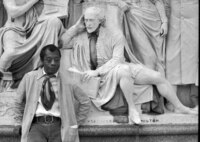 1969, James Baldwin visits the Albert Memorial in London